
Employee benefits in China: the complete 2026 guide
China’s benefits system is built on one structure — the “five insurances and one fund” — set nationally and priced locally. Get that right and most of the rest is custom and competition. Here is what is mandatory, what is expected, what it costs in the major cities and where foreign employers go wrong.
The structural point
Contribution rates, bases and caps are set city by city and reset every year, usually in July. A Shanghai employee and a Shenzhen employee on the same salary cost different amounts and their housing fund works differently. A provider who quotes you “the China rate” without asking which city has not started the calculation.
On this page
The five insurances and one fund (五险一金)
Every employer in China must enrol every employee in the statutory social insurance system and the housing provident fund, and contribute monthly on a base derived from the employee’s salary, bounded by local floors and caps.
| Component | What it covers | Who pays |
|---|---|---|
| Pension | Basic retirement pension after 15 years of contributions | Employer and employee |
| Medical | Hospital and outpatient care through the public system; maternity insurance is now merged into it in most cities | Employer and employee |
| Unemployment | Benefit after involuntary job loss with at least one year of contributions | Employer and employee |
| Work-related injury | Treatment and compensation for workplace injury and occupational disease; rate varies by industry risk class | Employer only |
| Maternity | Maternity leave pay and delivery costs; administratively merged with medical insurance in most cities | Employer only |
| Housing provident fund | Individual savings account for home purchase, rent or mortgage; withdrawable under local rules | Employer and employee, equal rates |
The contribution base is normally the employee’s average monthly wage in the previous year, subject to a floor (typically 60 per cent of the local average wage) and a cap (typically 300 per cent). Shanghai’s 2026 cap is around RMB 36,500 per month; above that, contributions stop rising while individual income tax continues. Under-declaring the base to save money is the most common compliance failure by foreign employers and has become materially riskier as collection has moved into tax-authority enforcement.
What it costs: Shanghai 2026 benchmark
Shanghai is the usual benchmark because it is the largest first-tier market and publishes clearly. Other first-tier cities fall within a few points either side.
| Component | Employer | Employee |
|---|---|---|
| Pension | 16% | 8% |
| Medical (incl. maternity) | 10% | 2% |
| Unemployment | 0.5% | 0.5% |
| Work injury | 0.16–1.52% by industry | — |
| Housing fund | 7% | 7% |
| Total | ~33.7–35% | 17.5% |
Worked example for a Shanghai employee on RMB 25,000 gross per month: employer contributions of roughly RMB 8,450 bring the monthly employer cost to about RMB 33,450 before any 13th-month accrual, commercial insurance or EOR fee. The employee takes home the gross less 17.5 per cent contributions and individual income tax on the remainder. For someone on RMB 60,000, the employer percentage falls because the base is capped — a point worth modelling for senior hires.
City variation in one line
Housing fund rates range from 5 to 12 per cent depending on the city and the employer’s choice within the local band; pension and medical rates are broadly harmonised at 16 and around 9–10 per cent for employers; work injury depends on industry. Beijing, Shenzhen and Guangzhou each publish their own bases and caps every year.
Leave and public holidays
- Statutory annual leave is based on cumulative working life, not tenure with you: 5 days after one year of total employment, 10 days after ten years, 15 days after twenty. Many employers add contractual days on top.
- Public holidays: 13 days per year since 2025, when Lunar New Year’s Eve and 2 May were added. The government publishes each year’s calendar, including the “adjusted” working weekends that bracket long holidays — a feature that surprises foreign employers every year.
- Sick leave is paid at a reduced rate set locally, generally between 60 and 100 per cent of wages and never below 80 per cent of the local minimum wage, with a statutory medical treatment period of 3 to 24 months during which the employee cannot be dismissed.
- Marriage leave: 3 days nationally, extended to 10 or more in many provinces. Bereavement leave: typically 1 to 3 days.
Maternity, paternity and family leave
- Maternity leave: 98 days nationally, extended by every province — 158 days in Shanghai and Beijing, up to 190 in some provinces. Paid through the maternity insurance fund at the employer’s average contribution wage; where the employee’s salary is higher, the employer usually tops up.
- Paternity leave: set by province, commonly 15 days in Shanghai, Beijing and Guangdong, up to 30 in some provinces; paid by the employer.
- Parental leave: introduced province by province since 2021, typically 5 to 10 days per parent per year until the child is three.
- Breastfeeding time: one hour per day until the child is one year old.
Dismissal of an employee during pregnancy, maternity leave or the breastfeeding period is prohibited except for serious misconduct, and a fixed-term contract expiring in that window is extended automatically.
13th month, bonuses and allowances
There is no statutory 13th-month salary in China, but an annual bonus paid before Lunar New Year is so universal that its absence is read as a signal. Budget for at least one month. The annual bonus has historically enjoyed a favourable separate individual income tax calculation, which has been extended repeatedly and currently runs to the end of 2027; your payroll provider should apply it.
Allowances are common and some are tax-efficient when properly structured and documented: meal, transport and communication allowances, and — for foreign employees — housing, children’s education, language training and home-leave travel, whose tax-exempt treatment has also been extended to the end of 2027.
Supplementary benefits
| Benefit | Position |
|---|---|
| Supplementary commercial medical insurance | Near-universal for professional roles; public medical insurance covers essentials but with co-pays and hospital restrictions. Group policies are inexpensive and expected. |
| Enterprise annuity | Voluntary occupational pension with tax advantages within limits; more common at large employers. |
| Supplementary housing fund | Additional employer housing contribution above the statutory rate, popular in Shanghai. |
| Annual health check | Widely offered and appreciated. |
| Additional leave | Extra annual leave above the statutory schedule is one of the most valued perks. |
| Festival gifts and allowances | Mid-Autumn and Lunar New Year gifts or cash are customary in many companies. |
Foreign employees
Foreign nationals working in China with a valid work permit are in principle required to participate in social insurance, with exemptions under bilateral totalisation agreements (Germany, South Korea, Japan and a number of others). Implementation varies by city — Shanghai historically treated participation as optional for foreigners and has moved towards mandatory enrolment. Housing fund participation for foreigners is generally optional. Confirm your city’s current rule rather than relying on last year’s.
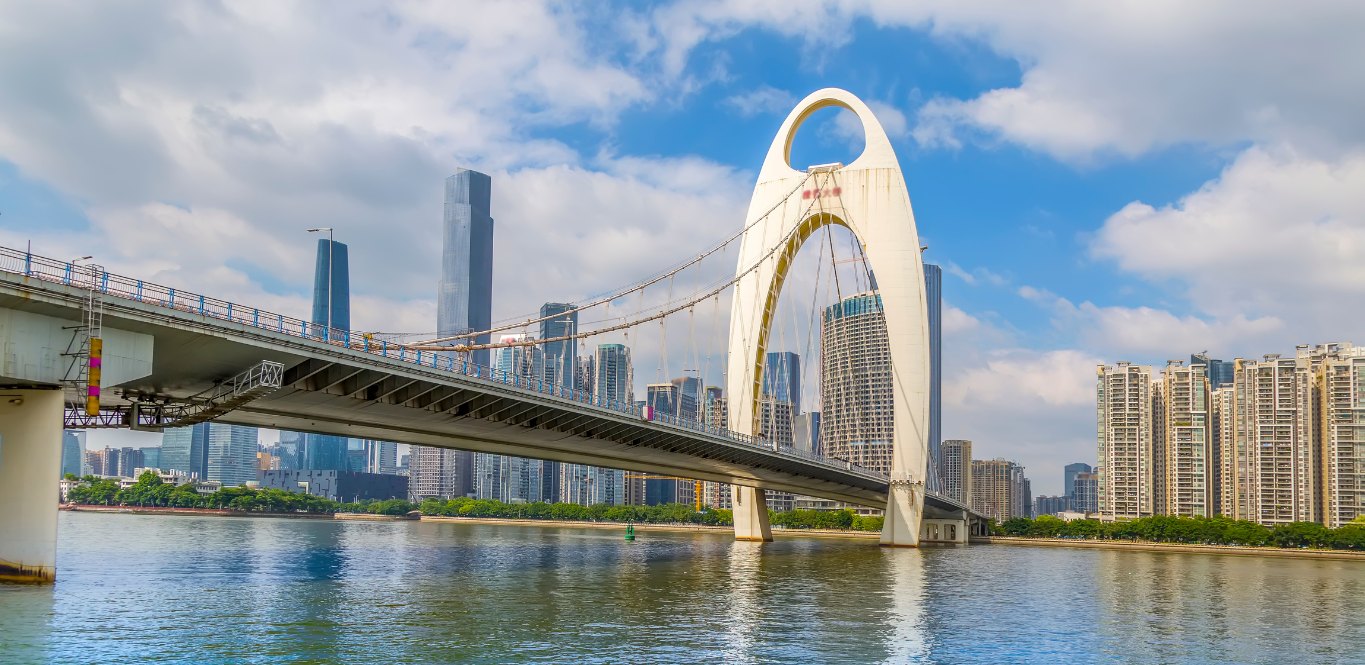 Guangzhou — Guangdong sets its own social insurance bases and housing fund rules
Benefits are where providers differ most
Statutory obligations are the same for everyone in a given city. What separates providers is whether they declare the right base, handle city-level variation without prompting, and actually operate commercial medical and annuity schemes rather than list them.
Related guides
Frequently asked questions
Which benefits are mandatory in China?
The five social insurances — pension, medical, unemployment, work injury and maternity — and the housing provident fund, for every employee, on a properly declared base. Plus statutory annual leave, public holidays, paid sick leave at the local rate, and maternity and paternity leave. A 13th month is customary, not statutory, but budget for it.
How much do employer contributions add to salary?
Roughly a third in the first-tier cities — about 33.7 to 35 per cent in Shanghai for 2026 — on a base capped at about three times the local average wage. The percentage therefore falls for high earners. Add the housing fund rate your city and employer choice specify.
Can we pay contributions on a lower base to save money?
No. The base is the employee’s actual average wage within the local floor and cap. Under-declaration is widespread historically and increasingly penalised now that collection sits with the tax authorities and courts award back-contributions with late fees. It is also a common reason employees bring claims at termination.
Is the 13th-month salary required?
Not by law. It is by custom, in practically every white-collar sector, and it is typically paid before Lunar New Year. Its absence will be noticed at recruitment. Its individual income tax treatment is favourable under a separate calculation currently extended to the end of 2027.
How many public holidays are there?
Thirteen since 2025, when two days were added. The State Council publishes the exact calendar each year, including “adjusted” working Saturdays or Sundays that make up long holiday blocks — employees do work those days, and international teams need warning.
Do foreign employees pay into social insurance?
In principle yes, with exemptions under totalisation agreements with countries such as Germany, South Korea and Japan, and city-level variation in practice. Housing fund is generally optional for foreigners. Ask your provider what your city currently requires.
Sources
Reviewed September 2026. General information, not legal or tax advice. Rates and caps are reset annually by each city; confirm the current figures before relying on them.
- Shanghai Municipal Government — social insurance rates and bases
- PwC Tax Summaries — China, individual, other taxes
- MSA Asia — China’s social security system 2026
- NNRoad — Employer contributions in China 2026
- Acclime — Chinese social security system at a glance
- State Council of the PRC — annual public holiday arrangements